
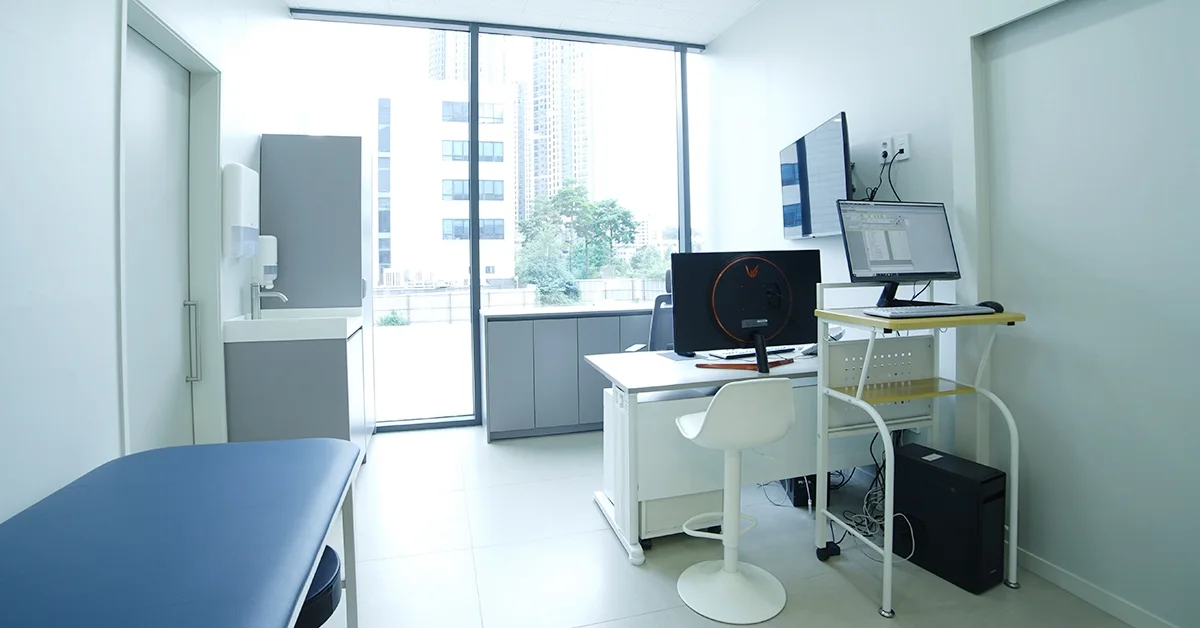
Yes — Seoul Gunwoo Orthopedic Surgery Clinic (서울건우정형외과의원) performs ankle ligament reconstruction in Seoul. Its official page states that it first performs anatomical Modified Broström ligament repair, and when the ligament is worn away or re-torn so that repair is not possible, it reconstructs the ligament with an autograft (your own tendon) or allograft (donor tendon).
Associated cartilage injury can be treated arthroscopically at the same operation. The clinic describes minimally invasive small incisions and firm fixation, followed by bracing and staged rehabilitation.
- Modified Broström anatomical repair
- Repair augmentation with surrounding tissue (e.g. extensor retinaculum, joint capsule)
- Ligament reconstruction with autograft or allograft tendon
- Arthroscopic treatment of associated cartilage injury
- Assessment: anterior drawer and talar tilt tests, X-ray, MRI, stress X-ray
Repair or reconstruction?
| Option | When it is used | What is done |
|---|---|---|
| Nonsurgical care | Acute sprains and instability that responds to rehabilitation | Brace or cast, medication, physiotherapy, ankle strengthening |
| Modified Broström repair | Most common operation for chronic instability | Your own torn ligament is re-attached and tightened anatomically |
| Augmented repair | When extra strength is needed | Repair reinforced with surrounding tissue such as the retinaculum or capsule |
| Ligament reconstruction | Ligament worn away or re-torn; repair not possible | A new ligament is created with an autograft or allograft tendon |
How chronic instability is assessed
- Anterior drawer test and talar tilt test for ligament stability
- X-rays to check for associated fractures
- MRI for the extent of ligament tear and cartilage damage
- Stress X-rays when chronic instability needs to be quantified
When surgery is considered
Surgery is usually discussed when the ankle keeps giving way despite a period of bracing and rehabilitation, or when examination and imaging show a ligament that will not stabilise on its own. Bring previous imaging and a description of how often the ankle gives way.
Questions to ask your surgeon
- Do I need repair (Modified Broström) or reconstruction — and why?
- If reconstruction, will you use an autograft or allograft?
- Is there cartilage, peroneal tendon or other associated injury to treat at the same time?
- How long will I wear a brace and when can I bear weight?
- When can I return to running and sport?
- What does the estimate include?
Recovery
A brace is worn after surgery, followed by range of motion, then strength, then balance and proprioception training. Return to sport is decided step by step according to the injury and rehabilitation progress.
Questions patients ask
Does Seoul Gunwoo do reconstruction, or only repair?
Both. Modified Broström repair is performed first when the tissue allows; ligament reconstruction with autograft or allograft tendon is performed when the ligament is worn or re-torn.
Is the surgery arthroscopic?
The ligament repair or reconstruction is done through small incisions; associated cartilage injury is treated arthroscopically at the same operation.
How much does surgery cost?
No fixed surgery package price is published. Costs depend on the procedure, imaging, anaesthesia, materials, room type and rehabilitation, and on your insurance status in Korea. Published non-covered room surcharges are ₩100,000 (twin), ₩200,000 (single) and ₩250,000 (special single). Ask the clinic for a written, itemised estimate.